

Corporate Positioning
Some thoughts on the strategic sweet spot

When clients come in the door or call you up on a late night, they never say they have a “strategy problem” or a “Public Affairs problem”. They just have a problem they need to get fixed.
Sometimes they have an idea about the solution, but you can also sometimes agree on their analysis, but not the conclusion. “We do not do Public Affairs” is also a statement I have heard in the past, which btw incapsulates perfectly the defintion challenge that Public Affairs as a discipline has. For some, Public Affairs is perhaps just a fancy word for lobbyism. For others, it is the same as PR. For some its just irrelevant academic semantics, and they just want the job done.
Positioning is sometimes a better term, at least in the phase while you are doing the diagnosis of a problem. How to position yourself as an organization. How to position yourself as a CEO. Also, because positioning is what gives the strategy oxygen.
The sweet spot
When talking about positioning, it is in its essence about finding the strategic sweet spot.
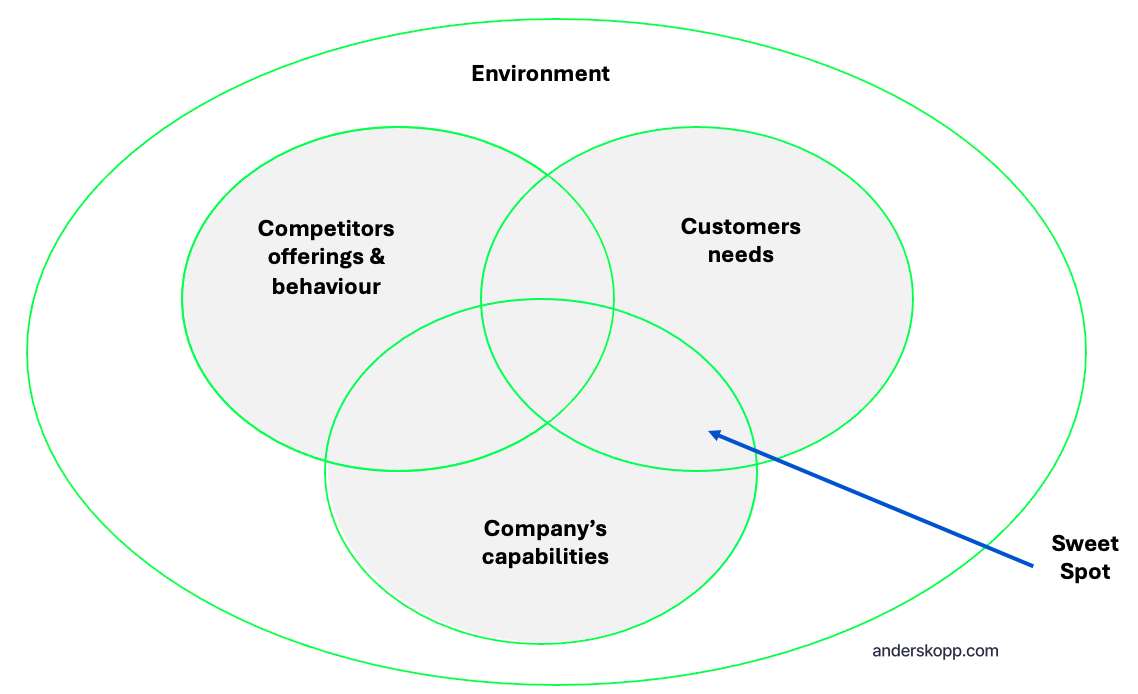
Inspired by Collis and Ruksta you can illustrate this like in the model above. Positioning is not about spinning something to fit your narrative, but finding out how to act - and in which order - based on a balance between the company’s capabilities, what the customers need, while you also look at what the competition does. All this of course happens in specific context or environment that shapes these three factors.
As advisors first and foremost, we need to reply to the companys needs, and also not be afraid to interfere with other disciplines - communications, sales, marketing, legal etc. - and maybe even slow things down if needed, if its not aligned with the positioning of the organization.
Sometimes I hear CEOs or founders talk about the need of a certain action or counter-measure due to competitors moving fast with something or a consensus has formed about a new topic that everybody just has to adjust to (like AI). Without even considering if it all applies to your specific situation.
Strategy professor Michael Porter talks about hypercompetition as a “self-inflicted wound, not the inevitable outcome of a changing paradigm of competition.” The root to this problem - Porter says - is to distinguish between operational effectiveness and strategy. And remember: Positioning is the heart of strategy.
/Kopp